

What is FarageWatch?
FarageWatch is a four-page, independent, fully sourced reality-check newsletter for Britain, about Nigel Farage, his Reform UK party, and the people and money around them.
It’s not a party leaflet. It doesn’t tell anyone how to vote.
It just does something you don’t see too often in British politics: it lays out what’s actually on the record – clearly, calmly, and in one place – and pushes it through real letterboxes.
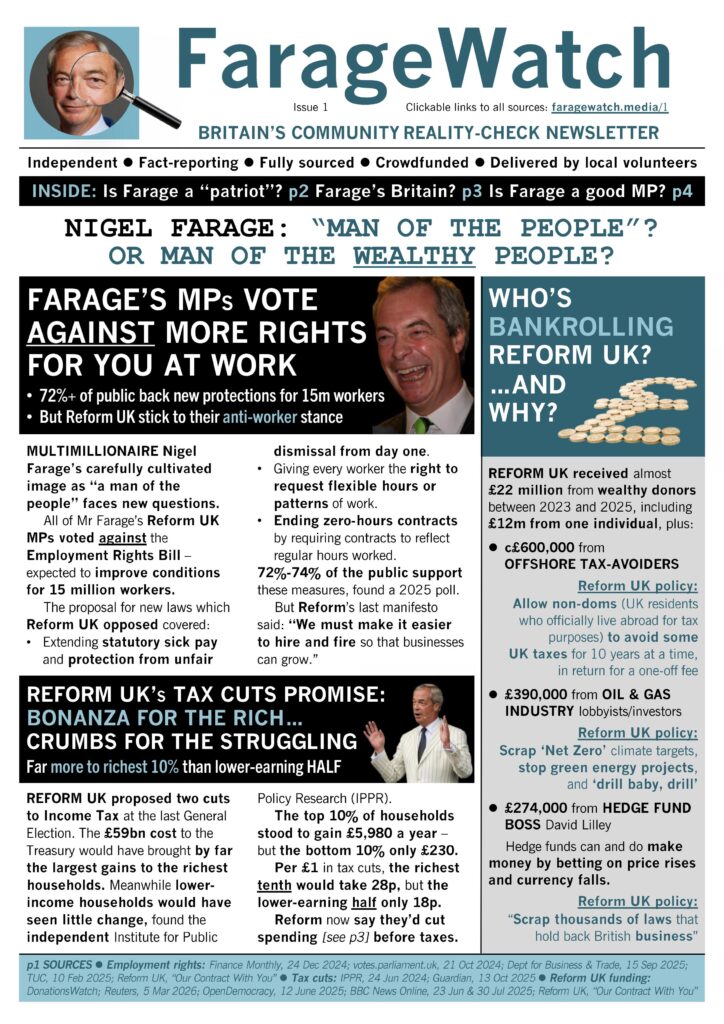
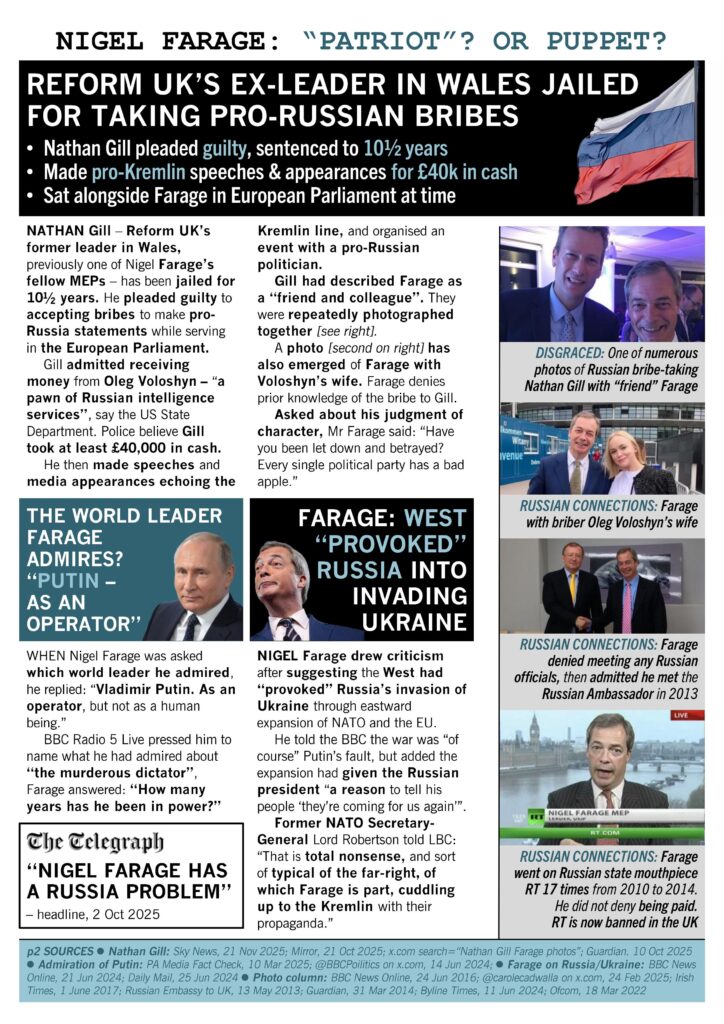
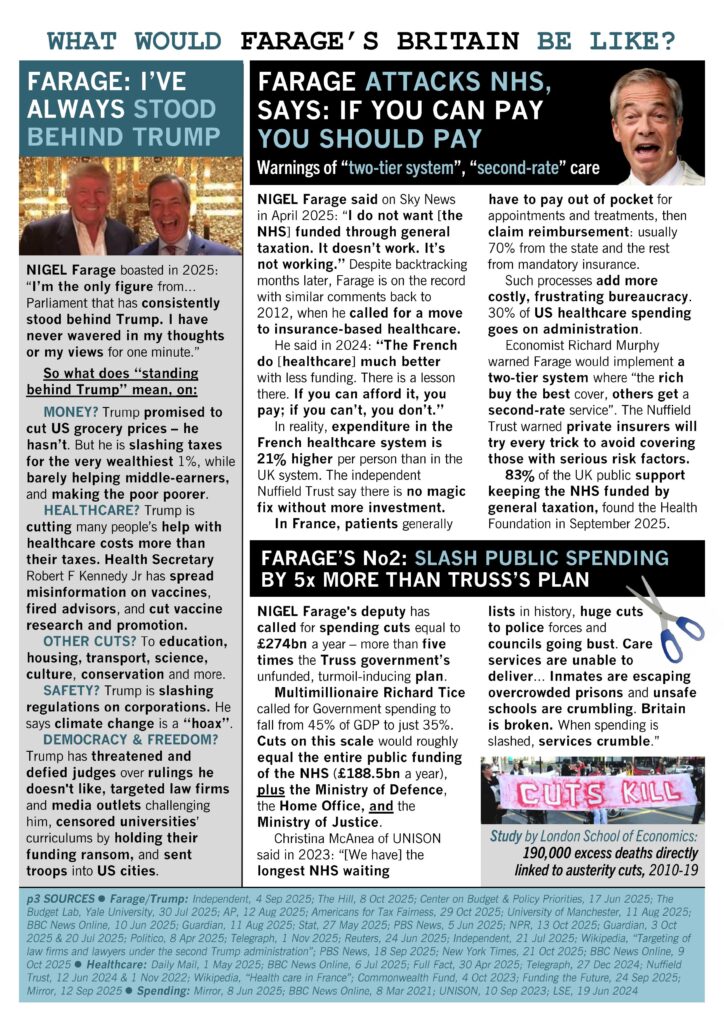
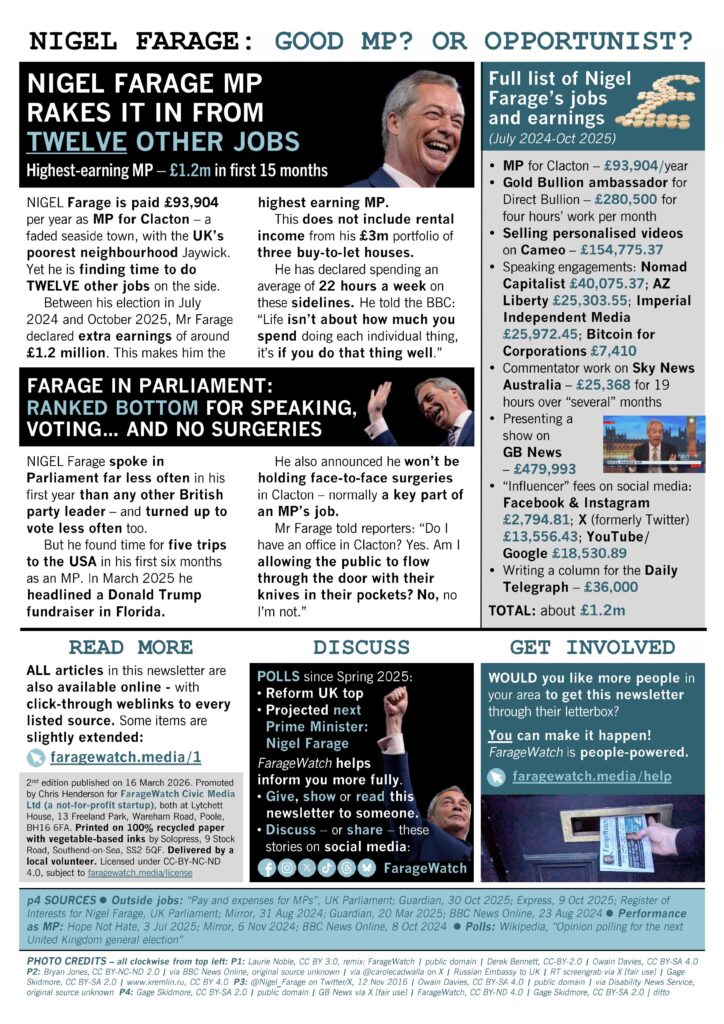
Each page of the newsletter asks a simple scrutiny question:
- Nigel Farage: “Man of the people”? Or man of the wealthy people?
- Nigel Farage: Patriot or puppet?
- What would Farage’s Britain be like?
- Is Farage a good MP?
Then it suggests answers, with three short, sourced stories per page.
Every copy is printed on 100% recycled paper with eco inks. The newsletter is Creative Commons licensed so others can reprint, adapt with their own imprint, and build local inserts.
Bundles are on sale now, sold at community at-cost prices to people who want to deliver them on their own streets – or fundraise and organise others in distribution around their town.
In short: FarageWatch turns money and frustration into something tangible – hard-hitting but fair journalism, through letterboxes, delivered by neighbours.
Why print – and why letterboxes?
There are reasons this isn’t just another online “explainer” project.
Reform UK’s support isn’t one blob
The first major study has dropped of who Reform UK’s supporters are since their recent surge. There are older “hardline” conservatives, anxious working-age voters, “reluctant” protest voters, even a younger contrarian strand. Some care most about immigration, some about the NHS, some about cost of living, some about basic fairness.
A major strand of their support are workers who are angry about their precarious financial positions, but want a government on their side as workers.
A significant number are only backing Reform out of frustration with mainstream politics and/or institutions, not because they’re convinced by their full platform or record.
The Reform-curious do not live in progressive social media bubbles, at all
People who never look for or click on political content on social media, never see it. They don’t see fact-checks unless someone puts them under their nose. If they do see political content on social media, it won’t be progressive-leaning content unless that’s what they engage with.
In fairness to the social media corporations, they don’t actually treat political content any differently to other kinds of content. Politics is just another “interest”. But if you’re a music fan whose thing is folk music, you don’t see posts on your social feeds about Top 40 music – and vice versa. It’s exactly the same algorithmic logic with different kinds of political content – left-leaning posts versus centrist posts versus right-leaning posts, trash meme political posts versus meaningful political journalism posts, and so on. The business model is that the algorithms show you what you like and identify with.
Digital echo chambers are toxic and thick-walled
When politics does show up in someone’s social media, it’s often at the level of a slogan, angry, tribal, or framed as entertainment. It’s vanishingly rare for indie bedroom content to carry any sources, and if it’s half-true or flat-out fake, it might go viral anyway. The angrier and more personalised the content, the more it circulates. Calm, sourced critique… doesn’t. Often, issues that actually matter don’t get the bulk of the attention. Especially when you’re going up against the Farage brand, GB News clips, and now openly MAGA-inflected messaging.
We’re up against a big media problem
Three-quarters of British newspapers are owned by right-wing billionaires, whose papers largely set the daily temperature of our politics. The BBC – while endlessly describing itself as “impartial” – quietly lifts its news agenda from those front pages, then announces with straight-faced neutrality that Reform UK are “setting the political weather”.
That’s how Farage ends up with an absurdly easy ride: the frame is already set, the questions stay shallow, and the national conversation gets funnelled into his preferred talking points – migration, outrage, grievance, culture war – instead of his record, his money, or the consequences of his policies.
Media itself is essential to democracy. What’s corrosive is the stranglehold: a few ultra-rich proprietors shaping the narrative, and a public broadcaster echoing it as ‘the centre ground’. Independent journalism hasn’t vanished – it’s just drowned out.
FarageWatch is a strategic contribution to the insurgency: a way for ordinary people to put sourced reality directly in each other’s hands, outside the billionaire filter, outside the BBC echo chamber, and outside the algorithm entirely. In other words: if the national news won’t ask the real questions, we’ll put them through the letterbox ourselves.
So FarageWatch takes a different route…
- Leaflets are mostly inescapable but non-intrusive. FarageWatch lands on top of the gas bill, the pizza menu and the charity shop appeal. Many people will drop it in the bin (perhaps at the other end of the corridor to the letterbox) – but they see it. They see the headlines, the photos, the source boxes. The newsletter is expertly designed to convey the key messages and storytelling in anything from just a casual 5-second glance before being tossed. But it also invites readers in, and invites them to stop, think, make new associations, and reflect.
- Letterboxes cut across the algorithm. No platform decides who gets to read FarageWatch Issue 1 on Farage’s twelve side-jobs, Russian money, NHS plans or billionaire backers. If a neighbour posts it through your door, it’s there.
- Local volunteers carry trust that “content” doesn’t. A leaflet from “some bloke up the road” lands very differently from a promoted video. It quietly says: someone round here thought this mattered enough to walk the streets.
The FarageWatch newsletter is designed primarily to get read by the people who are curious or undecided about Farage, don’t live on news sites, and definitely aren’t spending their evenings looking up political media. They deserve a reality-check in a format that comes to them, and often gets read to a greater or lesser extent.
Who the FarageWatch model is for – and how it works
FarageWatch is built to be supported by:
- ordinary people who are worried about a Farage-led government but don’t want to join a party;
- local activists who want to get out and about on their patch, but don’t have time to write and design a newspaper from scratch (or perhaps the money for expensive bespoke small quantities)
- donors and crowdfunders who want their money turned into something concrete, strategic and measurable.
The model is simple:
- Journalism and layout are done centrally – professionally edited and designed.
- Bundles are printed in bulk on recycled stock.
- Supporters buy bundles (100, 200, 500, 1,000, etc), which are shipped to their door.
- You, and/or people you rope in, deliver your bundles.
- This could be in small teams self-organising around streets, estates or villages.
- The FarageWatch office keeps a coverage tracker, and uses it to advise individual buyers when necessary on avoiding duplication of local streets.
- You can request to join the FarageWatch Community Forum, which has local groups where you can seek like-minded others to work together with on fundraising and/or distribution.
- [In a future phase of the FarageWatch project, we plan to add centralised crowdfunding, volunteer signup and matching.]
- Every issue is fully sourced and Creative Commons licensed, with clear instructions on how to re-imprint if local groups reprint it themselves.
No party logos. No “vote X” line. Just scrutiny, via print, at scale.
What FarageWatch covers – and what it doesn’t
FarageWatch isn’t a gossip sheet and it’s not a party-political attack ad.
It follows a simple editorial rule: cover what matters for the lives people actually lead, and ignore the noise.
What FarageWatch does cover
FarageWatch focuses on public actions, voting records, money, power, and the real-world consequences of decisions.
Issue 1 sets the tone:
- Workers’ rights – Farage and all Reform MPs voting against more protections at work, against stronger sick pay, and against day-one rights that polls show huge public support for.
- Reform’s tax policies at the last General Election – making the rich much richer, helping everyone else far less and the poor the least.
- Who funds Reform UK – the offshore donors, the fossil-fuel and hedge-fund interests.
- Foreign influence and patriotism – the case of Nathan Gill, Farage’s former MEP colleague and Reform’s ex-Welsh leader, admitting to taking bribes to make pro-Russia statements. Issue 1 lays out the facts, the court record, and Farage’s proximity to it.
- Farage’s media and ideological ecosystem – his admiration of Putin “as an operator”, shifting the blame to the West for Putin’s invasion of Ukraine, his years of paid appearances on RT, trying to deny he’d met the Russian ambassador… plus his repeated praise for Donald Trump, with a reminder of Trump’s record.
- Healthcare policy – Farage’s long record of arguing for an insurance-based, “if you can pay, you should pay” healthcare model, contrasted with France’s costs and red tape, and the overwhelming British support for funding the NHS through general taxation.
- Spending cuts and consequences – deputy Richard Tice’s call for spending cuts five times deeper than Liz Truss’s, with clear examples of what that would mean for public services and people’s lives.
- Money and representation – Farage earning £1.2 million in 15 months from twelve side jobs, plus income from property, while presenting himself as “a man of the people”.
These are shocks of reality, not shocks of scandal.
FarageWatch quotes only non-party voices in opposition to Farage’s record and policies.
Tabloid energy is the delivery mechanism – the journalism stays sourced, restrained and factual… yet always intentionally framed.
The jackpot goal is to trigger “hot cognition“. Average people don’t think hard about politics very often at all. But FarageWatch aims to prompt moments where people think, “Hang on… I didn’t know that” – and they read further, perhaps search online, because the story challenges the version of Farage they see on television and TikTok.
What FarageWatch doesn’t cover
FarageWatch avoids:
- culture-war bait, even when it’s tempting – recent research by Persuasion UK suggests that responding passionately on Farage’s favourite topics just makes them seem those topics even more disproportionately important for voting decisions
- party-political coverage or endorsements – no party agenda, no other parties’ names or branding, no ‘vote-for’ lines,
- anything unsourced or unverified
- moral lectures
- personal gossip, rumours or private-life speculation;
- policy or procedural minutiae that won’t affect daily life.
We don’t tell readers what to think. We just show them what’s true – clearly, calmly, and in a format that lands harder than a passing headline.
This is why FarageWatch works in print: when people see stripped-down, fact-heavy, slightly shocking stories about Farage’s record and inner circle – laid out tabloid-style, with photos, sources and no social-media noise – it cuts through the haze of political performance and forces a moment of real reflection.
That’s the whole point. Not outrage. Not factionalism. Just reality-checks, in your hands, delivered by your neighbours.
The money problem (and why FarageWatch is seeking some)
Let’s be blunt: Farage and Reform are not short of money.
- Reform’s donor list includes ultra-wealthy tax-avoiders, fossil-fuel interests and defence contractors. That’s before we even get to aligned media platforms.
- Nigel Farage has a long-standing relationship with US right-wing networks and MAGA funders who are quite open about wanting a harder, Trump-style right in Britain.
The progressive indie ecosystem is never going to match that pound-for-pound.
But it does need some serious money – enough to:
- pay for professional print runs and fulfilment;
- keep journalistic standards high;
- build the systems that let volunteers do the visible work.
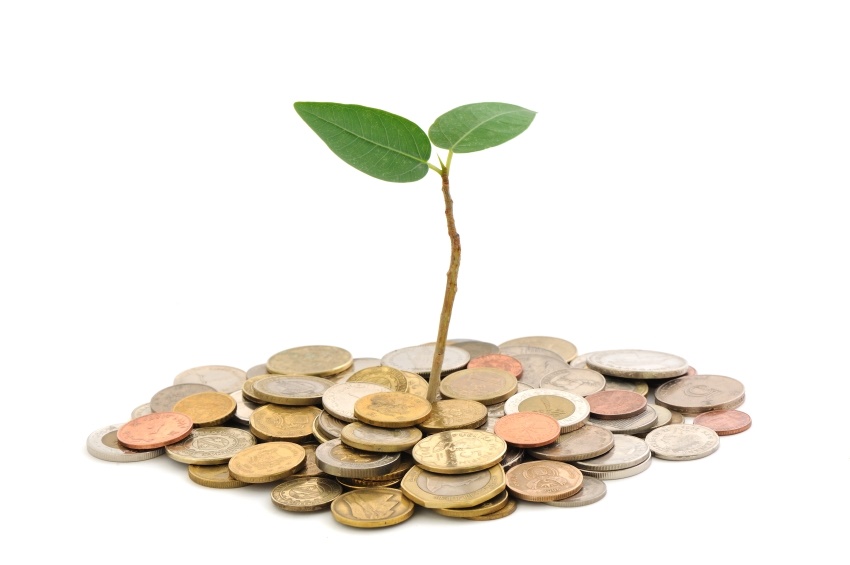
FarageWatch is a portal for that money:
- You put in the funding.
- Your funds are turned into a proper newspaper-style reality-check, printed at scale and sold cheaply to you in hundred bundles,
- and then carried street-by-street by people who actually live there.
It’s not “clicktivism.” It’s not a vibes-based hashtag.
It’s civic infrastructure: cheap, strategic, repeatable, and rooted in place.
About the founder
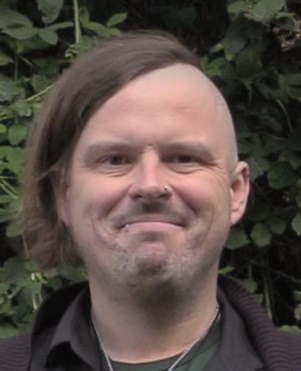
Chris Henderson [he/him] founded and coordinates FarageWatch Civic Media Ltd. He spends most of his studio work time turning political noise into compact short-form text and artwork people can actually use. Chris works at the overlap of political psychology, community administration experience, and old-school print craft.
He studied Sociology & Social Policy at Durham (where he was a sub-editor and journalist on Palatinate, and then a students’ union officer), later attained Graduate Membership of the British Psychological Society (GradDip LSBU) and then completed an MA in Political Psychology at Bournemouth, and has spent years working inside real community administration systems: adult social care, children’s services, complaints, voluntary-sector grants, and as a volunteer for charity and not-for-profit boards, a housing co-op, and a residents’ association. Nothing glamorous – just the sort of frontline bureaucracy where you learn how policies land on actual humans.
From 2014 onwards he progressively became deeply involved in grassroots political media, particularly in Dorset from 2018. He’s produced ward newsletters, councillor comms, and election materials for Green teams across the county, and helped normal people understand what their representatives were actually doing. He played a pivotal role in the rise of the Green Party in Bournemouth, from one councillor in 2018 to six councillors in 2023 – editing and producing most of the print that quietly did the work between elections – switching from volunteer to paid consultant in 2024 and 2025.
He also contracted for Dorset Green Party, helping bring key elements of councillor comms up to professional standard across the rural county. In 2024 he contracted with Green Party National Office to help coordinate the layout and production of part of the party’s General Election Freepost. Chris personally produced around 4 million of the 16 million leaflets sent to voters, working with several printers to keep deadlines met, quality high and chaos survivable.
Somewhere in there Chris also ran an indie “Stop the Tories” Facebook advertising campaign in 2017 that went semi-viral and earned a feature on BBC Trending – his first significant taste of what happens when you give ordinary people a clean message and something simple to do.
He’s spent years thinking about how and why ‘real people’ notice and engage with political messages – or don’t.
To keep his feet in everyday Britain rather than just on Zoom, Chris has also worked spells as a commercial leaflet distributor. Yes, sometimes it was pizza menus or estate agent letters. But other times it’s been the local council newspaper, or an indie community magazine, or local arts classes, or local horticulturalists, or a legally mandated public consultation about a destructive new big development, or a progressive independent school promoting its open days to their entire local community. People pay attention, and are surprisingly often grateful to you for posting to them. Chris has walked estates, terraces, inner-city mews and remote suburbs most commentators only see on polling charts. FarageWatch is partly a nod to that experience: real people, actual houses, no algorithm in sight.
FarageWatch as a project is the natural extension of all of that: a professionally printed, citizen-powered print project combining:
- responsible sourcing
- clear brief writing
- and the simple idea that people deserve practical, offline ways to understand political claims – without being shouted at by an algorithm – before they’re asked to vote for anyone… especially Nigel Farage.
Stylistically, Chris is what happens when you give a political psychologist a tabloid layout grid and a grudge against voting without basic key information. He likes:
- journalism that reads like a paper, not a press release
- centring Creative Commons licensing
- professional print and distribution logistics
- democracy projects that look powerful enough to make billionaires nervous.
Outside FarageWatch, Chris is also known as the seasonally resident video DJ in the niche London fandom of Sweden’s biggest music-as-peacemaking festival, and a goth-leaning media nerd who thinks frank civic newsletters and pop culture setlists belong in the same ethical universe: people making their own meaning, together, outside the algorithm’s chokehold.
Currently based back in South East London, Chris amicably stepped away in 2026 from freelance work supporting councillors and local Green campaigns locally in Dorset. FarageWatch as a fully independent, national demonstration/’proof of concept’ project is now his sole political campaigning focus: a small civic-media outfit trying to give ordinary voters something solid, accessible, and grounded in reality – delivered by neighbours, not machines.